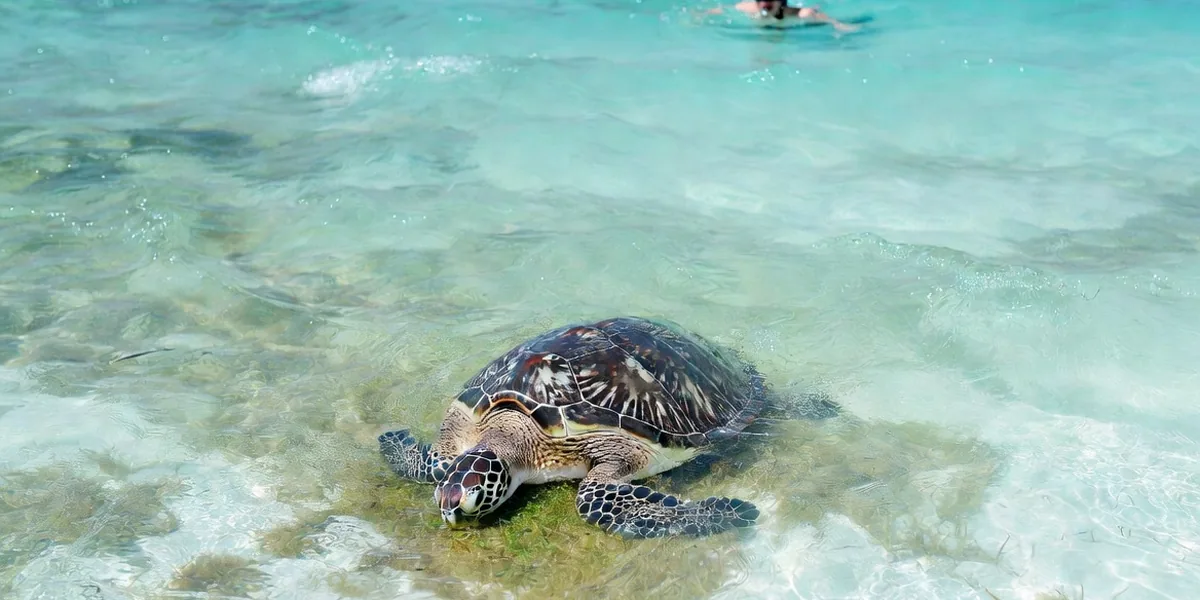

Akumal means "place of the turtles" in Maya, which is the kind of name a marketing team would invent if the animals were not already here eating grass in two meters of water.
They are still here. Green turtles, mostly, on the seagrass inside the reef. You can still get in the water with them in 2026. What you cannot do is wander into the middle of the bay in your drugstore snorkel like it is 2014. That version of the video is dead. The bay is a protected zone. A licensed guide, a vest, no chemical sunscreen, three meters of space, forty-five minutes, six people. That is the deal. If someone on the highway tries to sell you an "official entrance ticket" before you have even seen the sand, keep walking. The beach is public. The snorkel corridor is not.
How the Bay Actually Works
Three different waters get sold as "Akumal."
Akumal Bay (the main beach). This is the postcard. Shallow, protected, seagrass. The turtles are here because the food is here, not because a guide summoned them. Coral inside the bay is modest — you came for reptiles, not a wall dive. Inside the buoyed field, you go with a licensed guide or you do not go. Independent snorkeling is pushed to a near-shore corridor and the public stretch north of the main circus. You can still see a turtle from the shallows. You will see more of them, closer, with the guide. That is why the rule exists and also why the line exists.
Half Moon Bay. A few hundred meters north. Same town, different mood. Fewer wristbands, better coral, fewer guaranteed turtles, the occasional ray. Good when the main bay looks like a parking lot with snorkels.
Yal-Ku. Not a beach — a caleta where cenote water hits the Caribbean. Fish, halocline shimmer, no swell. Turtles are a bonus, not the product. Chemuyil and Xcacel sit down the 307 if you wanted a quieter turtle coast and fewer vests.
What You Will Pay in 2026
Nobody publishes one laminated national price, which is how the highway kiosk stays in business. This is the stack I would budget, September 2026:
| What | What people were paying | Notes |
|---|---|---|
| Beach walk-on | $0 | Public federal beach. No entrance fee on the access itself. |
| Parking at the main lot | ~100 MXN for the day | Closest lot. Not free. |
| Environmental / cooperative + guided turtle circuit | $15–20 USD in "fee" language, $25–40 USD all-in for a short licensed tour | Local circuits from about $38. That usually bundles wristband, vest, guide. |
| Highway "required ticket" | whatever they can get | Not required. Walk to the actual beach. |
| Cancún / Playa combo (ruins + turtles + a cenote) | $99–169 and up | Fine if you have no car and one day. A lot of van for one turtle. |
| Colectivo Playa del Carmen → Akumal | 40–50 MXN | Drops you at the pedestrian bridge. 30–40 min. Cash. |
| Colectivo Tulum → Akumal | same band, shorter | Flag the Tulum–Playa vans on 307. |
The Rules That Are Not Optional
- Licensed guide in the turtle field. A friend who "knows the bay" is not a license.
- Three meters. Do not close the gap for a phone. Do not hover over a turtle that is trying to surface. They breathe air. You are a ceiling.
- No touch, no ride, no feed. This is federal wildlife law, not a vibe. Fines are real.
- Vest on in the regulated zone. Yes, even if you swim the 200 at home.
- Fins off the seagrass if they tell you fins are out. The grass is the buffet. Your kick is a lawnmower.
- About 45 minutes. They rotate groups so the bay does not become a soup of tourists. Do not argue for a second lap because your cousin missed the shot.
- Hours roughly 8am–5pm for the official circuit. Morning is the whole strategy.
Can You Snorkel Without a Guide?
Yes, in the near-shore public water and outside the marked field. You might see a turtle. You might see a lot of knees. No, not in the protected seagrass where the density is the reason you came. That corridor has been guide-only for years. People still post videos of wandering in. People also still run red lights.
Half Moon Bay is the pressure valve. Still a wild animal, still no touching, usually a softer door.
When to Go
Turtles feed here all year. They are not a winter migration story.
- November–March. Clearer, less sargassum, more people who also read that sentence.
- April–June. Animals still working. Sargassum starts rolling the dice.
- July–August. Nesting season on this coast. The bay can still deliver. The beach at dusk is a different scene — give nesters room if you see a track.
- September–October. Storms, some sargassum, fewer buses from Cancún. I like it.
Time of day: first slot, 8am. The later you go, the more the water looks like a swim team. Sargassum sits on the surface and photographs badly. It does not evict the turtles from the grass. If the bay is a brown soup, walk to Half Moon or pay Yal-Ku and stop forcing the postcard.
How to Get There Without a $150 Van
Akumal sits on Highway 307 between Playa del Carmen and Tulum. About 30 km south of Playa, about 25 km north of Tulum town.
Colectivo. From Playa's Tulum-bound terminal, get on a van that says Tulum. Pay as you get off. 40–50 MXN, 30–40 minutes. Driver drops you at the crossing / pedestrian bridge. Walk over. Do not let a taxi at the off-ramp invent a crisis. From Tulum, same vans northbound — wave them down on 307. ADO / Mayab also roll the highway.
Car. Easy. Parking is the only plot twist — budget that 100 MXN and do not leave cameras on the seat.
Taxi from Tulum or Playa. Fine for a family, silly for two people who can count to cincuenta. I would not day-trip this from the Cancún Hotel Zone unless the alternative is sitting in the room. That is two hours of 307 for a 45-minute snorkel.
Who Should Book a Package Anyway
Kids, first-time snorkelers, anyone who wants the vest-and-photos handled. A one-day Tulum itinerary where ruins plus water is the whole plot. No Spanish, no cash, no interest in the colectivo game.
A local licensed circuit at $35–45 is the honest product. The $160 "VIP from Cancún" is the same turtle with more air-conditioning.
Book a Sea Turtle Snorkel Tour in Akumal
Guided snorkel tours with certified guides, equipment included. Also available as part of a Tulum and cenotes day trip from Cancún or Playa del Carmen.
A guest staying at the Riu Playacar did the guided turtle excursion mid-week and had turtles approaching within arm's reach — their one-line review: absolutely worth the money.
A visitor who has been coming to Akumal for years gives first-timers the same advice every time this comes up: take the dive-center tour on your first visit — gear, locker, and a guide who knows where the turtles feed — and decide on your second trip whether you want to go independent.
Several commenters made the same side note about the town itself: it is compact, relaxed, and easy to cover on foot, with a couple of shops worth a browse between swims.
Mr. Playas' read of the thread: it lands exactly where this page does. First visit, take the guide — the deeper seagrass zone is guide-only and actively watched, so treat the guide fee as part of the ticket rather than something to work around.
From a discussion on r/playadelcarmen.
What to Bring
Lycra or a cheap rashguard. Reef-unfriendly lotion stays in the bag. Cash in small bills. Your own mask if you have one that does not leak — rental masks are how people decide they "didn't see much." Water. Patience. Leave the drone. Leave the GoPro on a stick that you will inevitably swing toward a shell.
Is It Ethical, or Are We the Problem?
Both. The grass is why the turtles stayed. Too many fins and too many hands is how you lose the grass. The guide rule is the compromise that kept the bay open. Ignore it and you are the reason the next version of this page says "closed."
Watch. Do not herd. Get out when they say. Xcacel-Xcacelito down the road is a nesting sanctuary with a different personality — fewer snorkel circuses, more "sit down and let the beach work." If Akumal feels like a queue, that is the fork.
Akumal is the one spot on the Riviera Maya where you can wade in from the beach and be face-to-face with a sea turtle in five minutes. No boat, no $80 tour, no lottery. That is genuinely rare. But go at 8 AM — by 10 the bay is a traffic jam of snorkelers bumping into each other and the turtles head for deeper water.
The guide requirement for the deeper zone is worth it. Yes, it adds cost. But the guides know where the turtles are feeding, keep groups small, and the regulated access means the turtles stay calmer and more visible.
Akumal Bay vs Half Moon Bay vs Yal-Kú Lagoon
There are three distinct snorkeling areas in Akumal. Most visitors only see the main bay. Doing all three in a morning is possible and gives you three completely different underwater experiences.
Akumal Bay (main beach): Where the turtles are. Shallow seagrass beds, calm protected water, the guided turtle zone. The coral inside the bay itself is modest — you are here for the turtles, not the reef.
Half Moon Bay: About 700 meters north, accessed via a small road. Significantly less crowded. Fewer turtles than the main bay but better coral, more reef fish, and occasional eagle rays and nurse sharks.
Yal-Kú Lagoon: A natural inlet north of Half Moon Bay where freshwater from underground cenote systems mixes with seawater — a halocline effect, shimmering layers, abundant tropical fish. Turtles occasionally visit. Calmer and shallower than the bay, good for less confident swimmers and kids.
Akumal Monkey Sanctuary — The Family Stop

A few minutes inland on the road to Akumal, this rescue and rehabilitation center runs guided walks (about two hours) through enclosures of rescued capuchins, spider monkeys, macaws, and other animals — most surrendered as illegal pets or injured in the wild. Open 9 AM–5 PM daily, guided tours only. It pairs cleanly with a morning at the bay: turtles first while the water is calm, monkeys after lunch when the bay is crowded anyway.
A couple traveling with their 8-year-old booked a guided snorkel online before leaving Playa del Carmen: roughly $95 USD total for two adults and a child, covering the guide, gear, life vests, entrance fee, a locker, and underwater photos.
Their transport lesson is worth stealing: the bus they had planned on runs far less often than the internet suggests, and the colectivo stop was not where they expected. A taxi from Playa del Carmen saved the day for about $32.
One commenter's contrarian timing tip: late afternoon, when the day-trip crowd has cleared out, the bay empties and the low sun angle lights up the reef — the opposite play to the 8 AM strategy, and it works.
Mr. Playas' take: if you are bringing kids, booking ahead dissolves every logistics headache. And pair the trip with a cenote — Kantun Chi, right off Highway 307 with five cenotes on one site, came up in the same thread as the easy colectivo-friendly add-on.
From a discussion on r/playadelcarmen.
Akumal delivers what it promises: sea turtles in shallow water, reachable from the beach, no lottery involved. That is genuinely rare and worth the trip from anywhere on the Riviera Maya.
The best version of an Akumal day: arrive at 8 AM, do the guided turtle tour, walk north to Half Moon Bay for the reef, then drive 5 minutes to Cenote Dos Ojos. Lunch at the Lol-Ha restaurant on the beach. You will have had three completely different underwater experiences before 2 PM.
Combine Akumal with Cenote Dos Ojos
Guided day trips from Cancún, Playa del Carmen, and Tulum combine the Akumal turtle bay with Dos Ojos cenote — two completely different underwater worlds in one morning.
More Riviera Maya Guides
FAQ
Yes. Guided in the main field. Possible independently only outside it.
Plan $25–40 USD on site for a licensed short circuit, or about $38 on the big booking sites. Combos from Playa/Cancún start near $100 and climb. Beach entry is not a ticket.
In the regulated zone, yes.
No. Three meters. Federal.
Quieter, prettier reef, fewer guaranteed turtles. Different morning.
Some months. The turtles do not leave because Instagram is disappointed.
